The sameness of AI: why every website looks alike now — and what still sets you apart
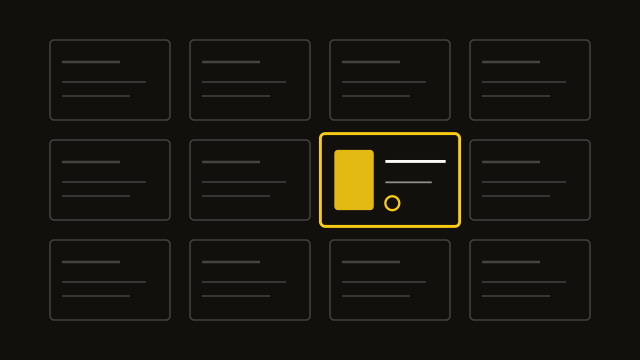
Open ten company websites in your industry, in ten tabs, and click through them fast. The hero image sits in the same place. Three feature cards line up in the same row. Somebody is passionate about innovation, somebody else is committed to excellence, and by the fourth tab you have stopped reading the words at all, because you already know what they are going to say.
This is not laziness. It is arithmetic. A great many businesses now reach for the same few AI tools, describe themselves in more or less the same sentence, and get more or less the same thing back. The output is good. That is the whole problem: it is good in precisely the way everybody else's is good.
It helps to know why this happens, because it is structural rather than a failure of taste. A language model returns something close to the middle of everything it was trained on. Ask for a modern, professional site for a consultancy and you receive the median of every page ever described that way — a composite of ten thousand consultancies, not one of them yours. That is a marvel when you need a competent draft before lunch. It is a liability when your competitors are typing the same sentence into the same box, because the middle is exactly where they already stand. The model is not letting you down. Averaging is the job.
Which quietly demolishes an advantage a lot of smaller businesses were leaning on. For years, simply having a website that looked professional put you ahead of competitors who had nothing, or something built in 2011 and never touched again. That gap has closed. Clean design, readable copy, a form that works, a page that loads while someone stands in a queue — the floor has risen and the price has fallen through it, which is wonderful for buyers and awkward for anyone who had been standing on that floor calling it a summit. These things keep you in the running now. They do not win anything. Whatever a competitor can produce from one sentence of prompt is not an advantage; it is a commodity with your logo on it.
Here is a test that takes two minutes and tends to sting. Cover your logo, and picture your closest competitor's in its place. Does a single sentence on the page become untrue?
If nothing breaks, you do not have positioning. You have a description of your industry, written in the industry's own voice. Run it on your About page too, and your services copy, and those three value propositions nobody has looked at since launch. We ran it on this site recently and did not much enjoy the result: our own homepage said we build things "around your organisation" — true, and also claimed by every studio on earth. We rewrote it to name the actual work, online storefronts and secure board elections, because that is a sentence a generalist cannot copy without lying.
So what survives? Proof, first, which is the most AI-resistant asset a business owns. A model will produce "bespoke solutions tailored to your needs" all day, at no cost, for anyone who asks. What it cannot produce is that we ran the 2026 board elections for the Institute of Internal Auditors Zambia — eligibility-gated, secret, auditable after the fact — or that a creditors' scheme-of-arrangement vote ran on a platform we built, where the result had to survive being challenged. Those sentences exist only because the work does. It is why our Work page is screenshots of real systems with the clients named, rather than stock photography and adjectives: it is the one part of the site nobody can reproduce by typing.
Then judgement, most of which is about what not to make. The value in a good project hides inside decisions — the section that should be cut, the feature nobody will use, the moment a template genuinely beats a custom build, the brief that confidently describes a solution when the real problem lies somewhere else. Ask a model for a page and you will get a page. It will not tell you the page shouldn't exist. It will not mention that your actual difficulty is that a stranger cannot work out what you do in the first five seconds. Someone has to make that call, and making it means occasionally being wrong in public, which is a thing software cannot do on your behalf.
Third, taste — which mostly means being willing to be disliked. Averages are inoffensive; that is what makes them averages. A brand with a spine makes choices that will lose somebody: a colour that isn't the safe one, a voice that sounds like a person rather than a committee, a layout that declines to be three columns. When we rebranded Sabango's Cakes we went jewel-toned and let the product photography carry the page. That is a decision rather than a consensus, and decisions are the only things anyone remembers afterwards.
Fourth, and least fashionable: somebody who answers. AI output is confident and unaccountable in equal measure — fine while it drafts a paragraph, considerably less fine at eleven at night when a board is disputing an election result, or when a regulator asks how member data is handled. This is not sentimentality about the human touch. It is a question of who carries the risk, and it is why organisations doing work that matters still want the name of the person on the other end, and some confidence that the same person will be there in year two.
It would be strange to write any of this without saying where we stand on the tools, so: we use them daily. They take the parts of a build that need no judgement and hand back hours, which go into brand, structure, and words — the parts that do. That is the right relationship. AI is the floor, not the ceiling. Raise the floor with it, then spend what you saved on everything it cannot touch. The businesses drifting into the flattened middle are the ones who used it to skip the thinking, and are now puzzled that a perfectly professional website has produced nothing at all.
The conclusion cuts both ways. Differentiation has become harder and more valuable in the same motion, because when the baseline is free, everything worth paying for sits above it. If you look at your own site and cannot say in one plain sentence what makes it yours rather than anyone's, that is not a design problem and a nicer template will not fix it. It is a positioning problem. Those are far cheaper to solve in a conversation than in a rebuild.
Written by

Sampa Sampa
Lead Consultant, Triple F Solutions
Sampa brings 16 years of experience in IT audit, risk, advisory, governance, and infrastructure from roles across the public and private sectors. A regular writer with published work, he's driven by using technology to help organisations succeed and is committed to continuous learning and improvement. Outside of work, he's into travel, martial arts, photography, research, and creative digital design.